
Count and Rate Outcomes: Rate Ratio Analysis
mlumr package
2026-02-06
Source:vignettes/count_rate_outcomes.Rmd
count_rate_outcomes.RmdOverview
This vignette demonstrates how to use ML-UMR for count/rate outcomes where the treatment effect is measured as a rate ratio (RR). Common applications include:
- Exacerbation rates in COPD/asthma
- Relapse rates in multiple sclerosis
- Infection rates (e.g., UTIs, respiratory infections)
- Adverse event rates
- Hospitalization rates
- Fracture rates in osteoporosis
The Poisson likelihood models event counts accounting for varying exposure times (follow-up duration).
Clinical Scenario
Consider comparing two treatments for chronic obstructive pulmonary disease (COPD):
- Treatment A (index): New inhaled therapy - IPD available from a Phase 3 trial
- Treatment B (comparator): Standard inhaled corticosteroid - Only published aggregate data available
The primary endpoint is the annualized rate of moderate-to-severe COPD exacerbations.
Step 1: Prepare the Data
Understanding Rate Data
For Poisson models, we need: - Event count: Number of events per patient - Exposure time: Follow-up time (person-years at risk)
The rate = events / exposure time.
Simulate Realistic Clinical Trial Data
set.seed(2024)

# --- Index Treatment (IPD) ---
n_index <- 300

# Patient characteristics
ipd_data <- data.frame(
  patient_id = 1:n_index,
  treatment = "Treatment_A",

  # Baseline characteristics (prognostic factors)
  age = rnorm(n_index, mean = 65, sd = 8),
  fev1_percent = rnorm(n_index, mean = 45, sd = 12),  # % predicted FEV1
  prior_exacerbations = rpois(n_index, lambda = 1.5), # Prior year count
  smoker = rbinom(n_index, 1, prob = 0.35)            # Current smoker
)

# Follow-up time varies (mean ~1 year)
ipd_data$followup_years <- rgamma(n_index, shape = 10, rate = 10)

# True model parameters for Treatment A (log-rate scale)
alpha_A <- log(0.8)  # Baseline rate ~0.8 events/year
beta_age <- 0.02     # Older = higher rate
beta_fev1 <- -0.015  # Lower FEV1 = higher rate
beta_prior <- 0.3    # Prior exacerbations strongly predictive
beta_smoker <- 0.25  # Smoking increases rate

# Generate event counts
log_rate_A <- with(ipd_data, {
  alpha_A +
    beta_age * (age - 65) +
    beta_fev1 * (fev1_percent - 45) +
    beta_prior * (prior_exacerbations - 1.5) +
    beta_smoker * smoker
})

ipd_data$exacerbation_count <- rpois(n_index,
  lambda = exp(log_rate_A) * ipd_data$followup_years)

# --- Comparator Treatment (AgD) ---
# Different population (older, more severe disease)
n_comparator <- 250

# True parameters for Treatment B (less effective)
alpha_B <- log(1.1)  # Higher baseline rate

# Simulate comparator population (not observed)
age_comp <- rnorm(n_comparator, mean = 68, sd = 7)
fev1_comp <- rnorm(n_comparator, mean = 40, sd = 10)
prior_comp <- rpois(n_comparator, lambda = 2.0)
smoker_comp <- rbinom(n_comparator, 1, prob = 0.30)
followup_comp <- rgamma(n_comparator, shape = 10, rate = 10)

log_rate_B <- alpha_B +
  beta_age * (age_comp - 65) +
  beta_fev1 * (fev1_comp - 45) +
  beta_prior * (prior_comp - 1.5) +
  beta_smoker * smoker_comp

events_comp <- rpois(n_comparator, lambda = exp(log_rate_B) * followup_comp)

# Create aggregate summary (what's published)
agd_data <- data.frame(
  study = "Comparator_Study",
  treatment = "Treatment_B",

  # Outcome summary
  total_events = sum(events_comp),
  total_exposure = sum(followup_comp),

  # Covariate summaries
  age_mean = mean(age_comp),
  age_sd = sd(age_comp),
  fev1_percent_mean = mean(fev1_comp),
  fev1_percent_sd = sd(fev1_comp),
  prior_exacerbations_mean = mean(prior_comp),
  prior_exacerbations_sd = sd(prior_comp),
  smoker_mean = mean(smoker_comp)  # Proportion (binary)
)

# Display summary
cat("IPD Summary (Treatment A):\n")
#> IPD Summary (Treatment A):
cat("  N =", n_index, "\n")
#>   N = 300
cat("  Total events =", sum(ipd_data$exacerbation_count), "\n")
#>   Total events = 294
cat("  Total exposure =", round(sum(ipd_data$followup_years), 1), "person-years\n")
#>   Total exposure = 300 person-years
cat("  Crude rate =", round(sum(ipd_data$exacerbation_count) /
    sum(ipd_data$followup_years), 2), "events/year\n")
#>   Crude rate = 0.98 events/year
cat("  Age (mean/SD):", round(mean(ipd_data$age), 1), "/",
    round(sd(ipd_data$age), 1), "\n")
#>   Age (mean/SD): 65.3 / 7.9
cat("  FEV1% (mean/SD):", round(mean(ipd_data$fev1_percent), 1), "/",
    round(sd(ipd_data$fev1_percent), 1), "\n")
#>   FEV1% (mean/SD): 45.1 / 11.7
cat("  Prior exacerbations (mean):", round(mean(ipd_data$prior_exacerbations), 2), "\n")
#>   Prior exacerbations (mean): 1.37
cat("  Current smokers:", round(mean(ipd_data$smoker) * 100, 1), "%\n\n")
#>   Current smokers: 36.7 %

cat("AgD Summary (Treatment B):\n")
#> AgD Summary (Treatment B):
cat("  N =", n_comparator, "\n")
#>   N = 250
cat("  Total events =", agd_data$total_events, "\n")
#>   Total events = 445
cat("  Total exposure =", round(agd_data$total_exposure, 1), "person-years\n")
#>   Total exposure = 248.2 person-years
cat("  Crude rate =", round(agd_data$total_events / agd_data$total_exposure, 2),
    "events/year\n")
#>   Crude rate = 1.79 events/year
cat("  Age (mean/SD):", round(agd_data$age_mean, 1), "/",
    round(agd_data$age_sd, 1), "\n")
#>   Age (mean/SD): 68.1 / 6.5
cat("  FEV1% (mean/SD):", round(agd_data$fev1_percent_mean, 1), "/",
    round(agd_data$fev1_percent_sd, 1), "\n")
#>   FEV1% (mean/SD): 39.7 / 9.7
cat("  Prior exacerbations (mean):", round(agd_data$prior_exacerbations_mean, 2), "\n")
#>   Prior exacerbations (mean): 2.03
cat("  Current smokers:", round(agd_data$smoker_mean * 100, 1), "%\n")
#>   Current smokers: 30.8 %
Key Population Differences
cat("\nPopulation Differences (Index - Comparator):\n")
#>
#> Population Differences (Index - Comparator):
cat("  Age:", round(mean(ipd_data$age) - agd_data$age_mean, 1), "years\n")
#>   Age: -2.7 years
cat("  FEV1%:", round(mean(ipd_data$fev1_percent) - agd_data$fev1_percent_mean, 1), "%\n")
#>   FEV1%: 5.4 %
cat("  Prior exacerbations:",
    round(mean(ipd_data$prior_exacerbations) - agd_data$prior_exacerbations_mean, 2), "\n")
#>   Prior exacerbations: -0.66
cat("  Current smokers:",
    round((mean(ipd_data$smoker) - agd_data$smoker_mean) * 100, 1), "percentage points\n")
#>   Current smokers: 5.9 percentage points

cat("\nThe comparator population is older with more severe disease.\n")
#>
#> The comparator population is older with more severe disease.
cat("A naive comparison would be confounded by these differences.\n")
#> A naive comparison would be confounded by these differences.
Step 2: Set Up ML-UMR Data Structures
Prepare IPD
ipd <- set_ipd_unanchored(
  data = ipd_data,
  treatment = "treatment",
  outcome = "exacerbation_count",
  covariates = c("age", "fev1_percent", "prior_exacerbations", "smoker"),
  likelihood = "poisson",
  E = "followup_years"  # Exposure time column
)

print(ipd)
#> $data
#> # A tibble: 300 × 8
#>    .study    .trt   .outcome    .E   age fev1_percent prior_exacerbations smoker
#>    <chr>     <chr>     <int> <dbl> <dbl>        <dbl>               <int>  <int>
#>  1 IPD_Study Treat…        0 1.10   72.9         53.5                   0      0
#>  2 IPD_Study Treat…        1 0.776  68.7         37.4                   0      0
#>  3 IPD_Study Treat…        1 0.782  64.1         41.2                   3      1
#>  4 IPD_Study Treat…        3 1.28   63.3         57.8                   2      0
#>  5 IPD_Study Treat…        1 0.950  74.3         64.1                   2      1
#>  6 IPD_Study Treat…        2 0.757  75.3         50.4                   3      1
#>  7 IPD_Study Treat…        1 0.835  69.3         43.7                   1      0
#>  8 IPD_Study Treat…        0 1.63   64.0         53.6                   2      0
#>  9 IPD_Study Treat…        1 0.924  55.2         47.2                   2      1
#> 10 IPD_Study Treat…        2 1.03   56.0         60.8                   4      1
#> # ℹ 290 more rows
#>
#> $n
#> [1] 300
#>
#> $n_events
#> [1] 294
#>
#> $treatment
#> [1] "Treatment_A"
#>
#> $covariates
#> [1] "age"                 "fev1_percent"        "prior_exacerbations"
#> [4] "smoker"
#>
#> $likelihood
#> [1] "poisson"
#>
#> $type
#> [1] "ipd"
#>
#> attr(,"class")
#> [1] "ipd_unanchored" "list"
Prepare AgD
For Poisson likelihood AgD, we need: - outcome_r: Total
event count - outcome_E: Total exposure (person-years)
agd <- set_agd_unanchored(
  data = agd_data,
  treatment = "treatment",
  outcome_r = "total_events",
  outcome_E = "total_exposure",
  cov_means = c("age_mean", "fev1_percent_mean", "prior_exacerbations_mean", "smoker_mean"),
  cov_sds = c("age_sd", "fev1_percent_sd", "prior_exacerbations_sd", NA),  # NA for binary
  cov_types = c("continuous", "continuous", "continuous", "binary"),
  likelihood = "poisson"
)

print(agd)
#> $data
#> # A tibble: 1 × 11
#>   .study    .trt      .r    .E age_mean age_sd fev1_percent_mean fev1_percent_sd
#>   <chr>     <chr>  <int> <dbl>    <dbl>  <dbl>             <dbl>           <dbl>
#> 1 AgD_Study Treat…   445  248.     68.1   6.54              39.7            9.72
#> # ℹ 3 more variables: prior_exacerbations_mean <dbl>,
#> #   prior_exacerbations_sd <dbl>, smoker_mean <dbl>
#>
#> $n
#> [1] NA
#>
#> $n_events
#> [1] 445
#>
#> $treatment
#> [1] "Treatment_B"
#>
#> $covariates
#> [1] "age"                 "fev1_percent"        "prior_exacerbations"
#> [4] "smoker"
#>
#> $cov_info
#> $cov_info$age
#> $cov_info$age$mean_col
#> [1] "age_mean"
#>
#> $cov_info$age$sd_col
#> [1] "age_sd"
#>
#> $cov_info$age$type
#> [1] "continuous"
#>
#>
#> $cov_info$fev1_percent
#> $cov_info$fev1_percent$mean_col
#> [1] "fev1_percent_mean"
#>
#> $cov_info$fev1_percent$sd_col
#> [1] "fev1_percent_sd"
#>
#> $cov_info$fev1_percent$type
#> [1] "continuous"
#>
#>
#> $cov_info$prior_exacerbations
#> $cov_info$prior_exacerbations$mean_col
#> [1] "prior_exacerbations_mean"
#>
#> $cov_info$prior_exacerbations$sd_col
#> [1] "prior_exacerbations_sd"
#>
#> $cov_info$prior_exacerbations$type
#> [1] "continuous"
#>
#>
#> $cov_info$smoker
#> $cov_info$smoker$mean_col
#> [1] "smoker_mean"
#>
#> $cov_info$smoker$sd_col
#> [1] NA
#>
#> $cov_info$smoker$type
#> [1] "binary"
#>
#>
#>
#> $likelihood
#> [1] "poisson"
#>
#> $type
#> [1] "agd"
#>
#> attr(,"class")
#> [1] "agd_unanchored" "list"
Combine Data
network <- combine_unanchored(ipd, agd)
print(network)
#> Unanchored Comparison Data
#> ===========================
#>
#> Likelihood: poisson
#>
#> Index treatment (IPD): Treatment_A
#>   - N = 300
#>   - Count events = 294
#>
#> Comparator treatment (AgD): Treatment_B
#>   - Count events = 445
#>
#> Covariates ( 4 ): age, fev1_percent, prior_exacerbations, smoker
#>
#> Integration points: Not yet added (use add_integration_unanchored())
Step 3: Add Integration Points
Note: For the binary covariate (smoker), we use qbern
with probability equal to the proportion:
network <- add_integration_unanchored(
  network,
  n_int = 100,
  age = distr(qnorm, mean = age_mean, sd = age_sd),
  fev1_percent = distr(qnorm, mean = fev1_percent_mean, sd = fev1_percent_sd),
  prior_exacerbations = distr(qnorm, mean = prior_exacerbations_mean,
                              sd = prior_exacerbations_sd),
  smoker = distr(qbern, prob = smoker_mean)  # Binary covariate
)
#> Computing correlation matrix from IPD...
#> Added 100 integration points for AgD

print(network)
#> Unanchored Comparison Data
#> ===========================
#>
#> Likelihood: poisson
#>
#> Index treatment (IPD): Treatment_A
#>   - N = 300
#>   - Count events = 294
#>
#> Comparator treatment (AgD): Treatment_B
#>   - Count events = 445
#>
#> Covariates ( 4 ): age, fev1_percent, prior_exacerbations, smoker
#>
#> Integration points: 100 (QMC with Gaussian copula)
Visualize Covariate Distributions
p1 <- plot_covariate_distribution(network, "age")
p2 <- plot_covariate_distribution(network, "fev1_percent")
p3 <- plot_covariate_distribution(network, "prior_exacerbations")

print(p1)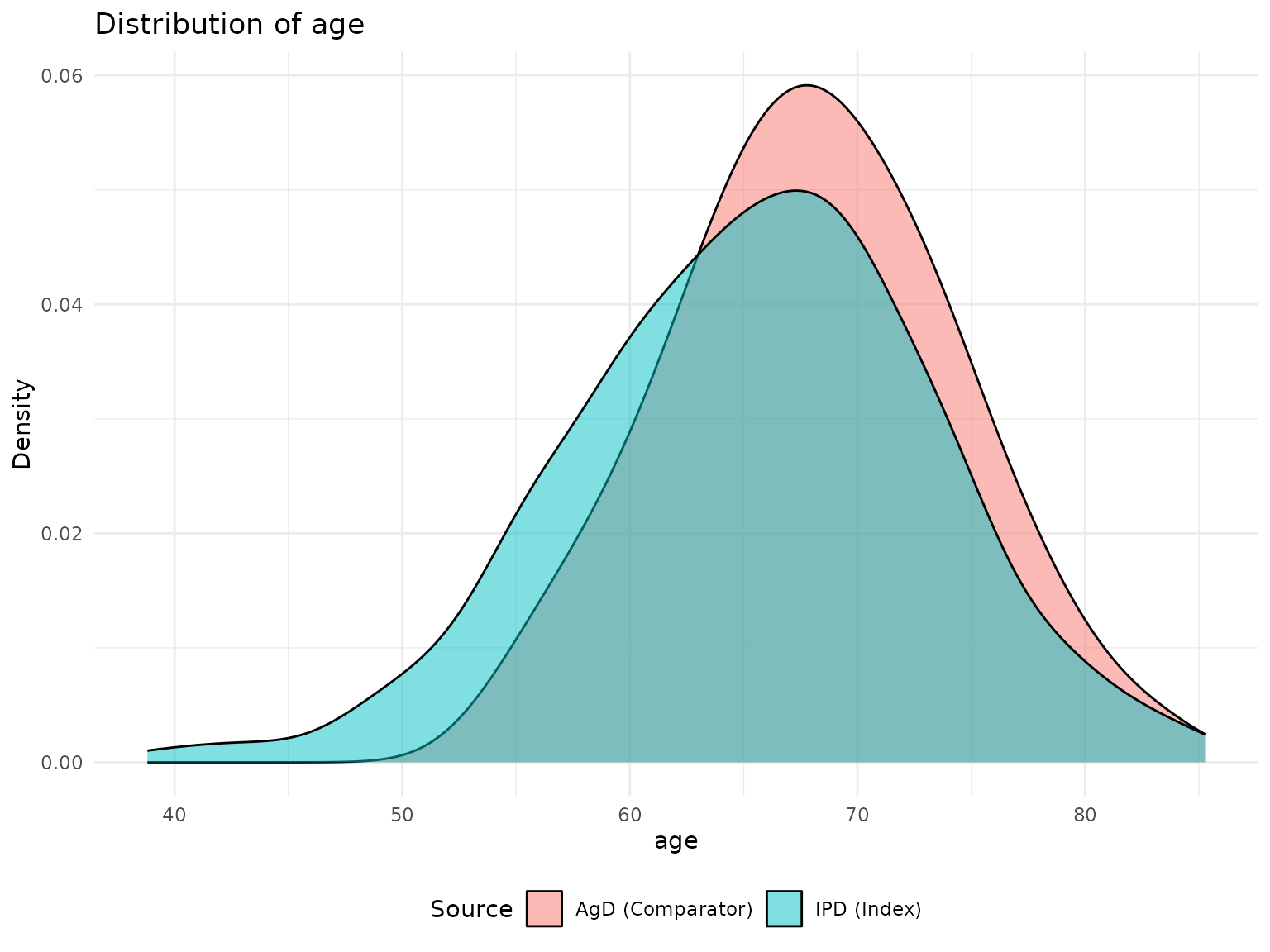
print(p2)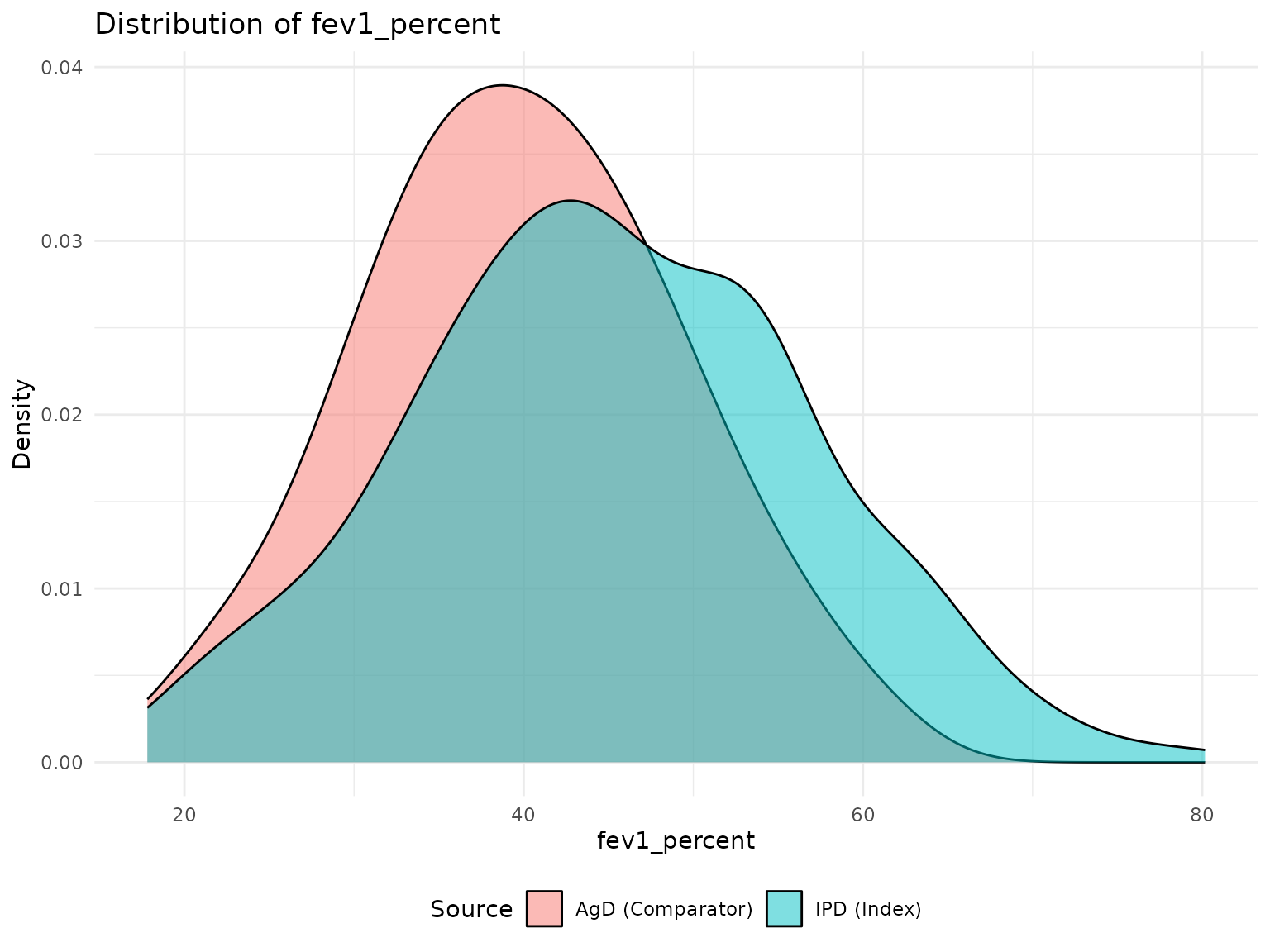
print(p3)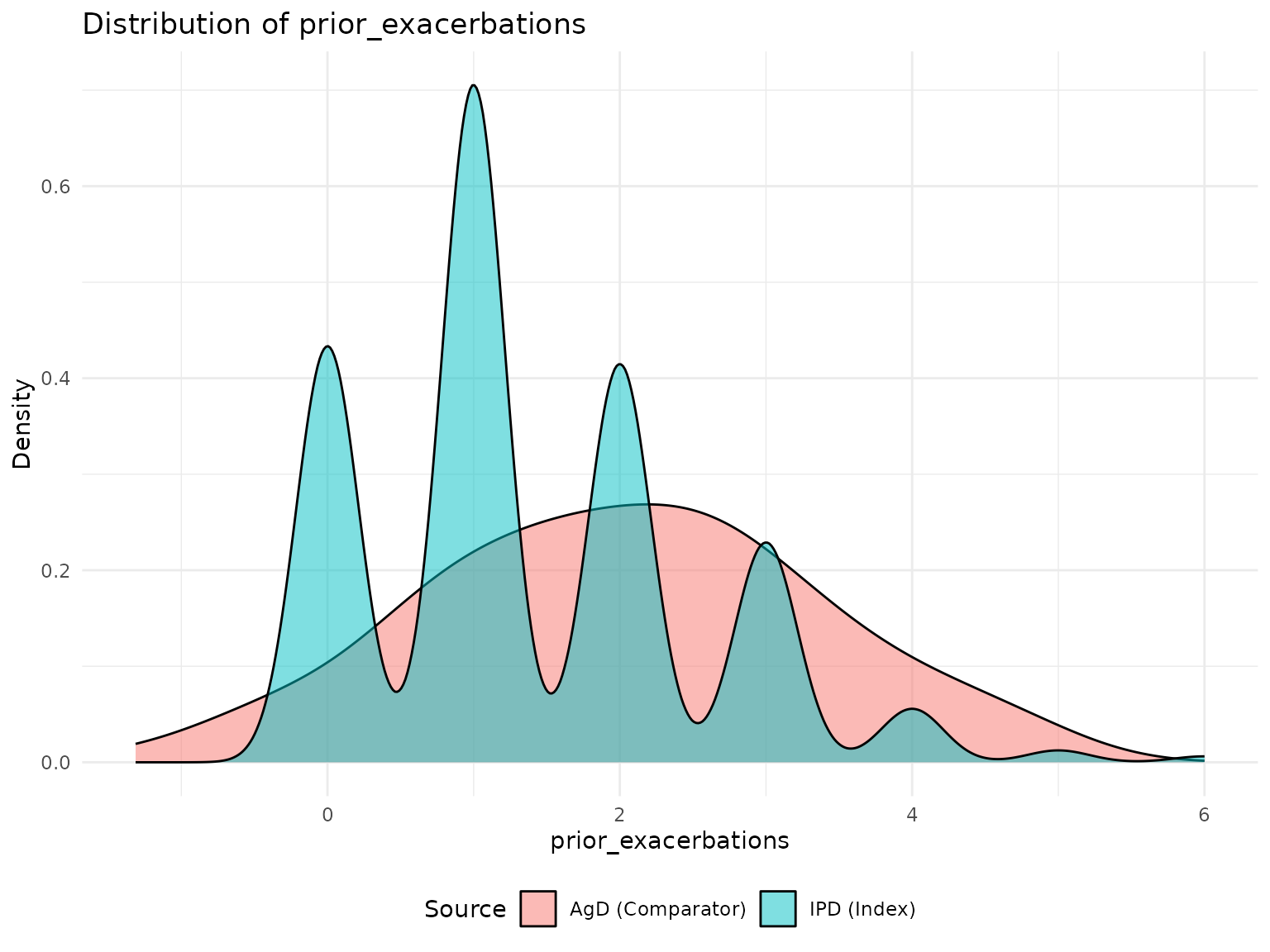
Step 4: Fit ML-UMR Models
Model with SPFA
fit_spfa <- mlumr(
  data = network,
  spfa = TRUE,
  prior_intercept = prior_normal(0, 2),  # Log-rate scale
  prior_beta = prior_normal(0, 1),
  iter_warmup = 1000,
  iter_sampling = 2000,
  chains = 4,
  seed = 123
)

print(fit_spfa)
summary(fit_spfa)
Model with Relaxed SPFA
fit_relaxed <- mlumr(
  data = network,
  spfa = FALSE,
  prior_intercept = prior_normal(0, 2),
  prior_beta = prior_normal(0, 1),
  iter_warmup = 1000,
  iter_sampling = 2000,
  chains = 4,
  seed = 123
)
Step 5: Extract Rate Ratios
Marginal Rate Ratios
For Poisson outcomes, marginal_effects() returns
rate ratios:
# Extract rate ratios in both populations
effects <- marginal_effects(fit_spfa, population = "both", effect_type = "rate_ratio")
print(effects)
Interpretation:
- Rate Ratio < 1: Treatment A has lower exacerbation rate (beneficial)
- Rate Ratio = 1: No difference between treatments
- Rate Ratio > 1: Treatment A has higher rate (harmful)
Forest Plot
plot_marginal_effects_forest(fit_spfa, effect_type = "rate_ratio") +
  geom_vline(xintercept = 1, linetype = "dashed") +
  labs(x = "Rate Ratio (Treatment A / Treatment B)")
Step 6: Model Comparison
# Compare SPFA vs Relaxed models
comparison <- compare_models(fit_spfa, fit_relaxed)

# If prior exacerbations are a stronger predictor for one treatment,
# the relaxed model may fit better
Clinical Interpretation
Understanding Rate Ratios
# Example output (hypothetical values):
#
# Effect        Population   Mean    SD    2.5%   97.5%
# RATE_RATIO    Index        0.72   0.08   0.57   0.89
# RATE_RATIO    Comparator   0.68   0.10   0.50   0.88
#
# Interpretation:
# - Rate Ratio of 0.72 means Treatment A reduces exacerbation rate by 28%
# - (1 - 0.72) * 100 = 28% reduction vs Treatment B
# - Consistent across populations (similar RR in both)
# - 95% CrI excludes 1, suggesting statistical significance
Clinical Significance
For COPD exacerbations: - Rate ratio < 0.85: Considered clinically meaningful - Rate ratio 0.70-0.80: Moderate reduction (typical for effective therapies) - Rate ratio < 0.70: Strong reduction
Number Needed to Treat (NNT)
# Calculate NNT from rate difference
# If baseline rate = 1.5 events/year
# And rate ratio = 0.72
# Treatment A rate = 1.5 * 0.72 = 1.08
# Rate difference = 1.5 - 1.08 = 0.42 events/year prevented

# NNT = 1 / rate_difference = 1 / 0.42 = 2.4
# Meaning: Treat ~2.4 patients for 1 year to prevent 1 exacerbation
Special Considerations for Rate Data
1. Exposure Time Handling
The Poisson model accounts for varying follow-up:
# IPD: Each patient has individual follow-up time
# AgD: Total exposure = sum of all patient follow-up times

# The model estimates rates (events/time), not counts
# This allows valid comparisons despite different follow-up durations
2. Overdispersion
The Poisson model assumes variance equals mean. In practice, rates may be overdispersed (variance > mean). Consider:
# Check for overdispersion in IPD
observed_var <- var(ipd_data$exacerbation_count)
expected_var <- mean(ipd_data$exacerbation_count)
dispersion_ratio <- observed_var / expected_var

cat("Dispersion ratio:", round(dispersion_ratio, 2), "\n")
cat("If >> 1, consider negative binomial model (not yet implemented)\n")
3. Zero-Inflation
If many patients have zero events, consider whether: - Sample size is adequate - Follow-up is long enough - The Poisson model is appropriate
4. Prior Selection for Log-Rate
# Priors are on the log-rate scale
# If baseline rate ~1 event/year, log(1) = 0
# N(0, 2) prior on intercept covers rates from ~0.02 to ~50

# For coefficients:
# N(0, 1) allows rate ratios from ~0.05 to ~20 per unit change
# More restrictive: N(0, 0.5) for rate ratios ~0.2 to ~5
5. Reporting Results
Standard reporting for rate outcomes:
# Report:
# 1. Absolute rates in each population
#    "The adjusted exacerbation rate was 0.85/year (95% CrI: 0.70-1.02)
#     for Treatment A and 1.18/year (95% CrI: 0.98-1.40) for Treatment B"
#
# 2. Rate ratio with confidence interval
#    "The rate ratio was 0.72 (95% CrI: 0.57-0.89)"
#
# 3. Rate difference (optional)
#    "Treatment A prevented 0.33 exacerbations per patient-year
#     (95% CrI: 0.15-0.52)"
Example: Multiple Sclerosis Relapse Rates
Here’s a template for MS relapse data:
# IPD structure for MS relapse study
ms_ipd <- data.frame(
  patient_id = 1:200,
  treatment = "Treatment_A",
  relapse_count = rpois(200, lambda = 0.3),  # Annual relapse count
  followup_years = runif(200, 0.5, 2),       # 6 months to 2 years
  age = rnorm(200, 40, 10),
  edss_baseline = rnorm(200, 3, 1.5),        # Disability score
  prior_relapses = rpois(200, lambda = 1)    # Prior year relapses
)

# AgD structure
ms_agd <- data.frame(
  treatment = "Treatment_B",
  total_relapses = 45,           # Sum of relapses
  total_exposure = 180,          # Person-years
  age_mean = 42, age_sd = 9,
  edss_baseline_mean = 3.5, edss_baseline_sd = 1.3,
  prior_relapses_mean = 1.2, prior_relapses_sd = 0.8
)
Summary
This vignette demonstrated:
- Setting up ML-UMR for count/rate outcomes with Poisson likelihood
- Handling exposure time for varying follow-up durations
- Using
outcome_r(total events) andoutcome_E(total exposure) for AgD - Interpreting rate ratios and converting to clinical metrics
- Mixing continuous and binary covariates in the integration
For binary outcomes, see the main tutorial vignette. For continuous outcomes, see the “Continuous Outcomes” vignette.
Session Information
sessionInfo()
#> R version 4.5.2 (2025-10-31)
#> Platform: x86_64-pc-linux-gnu
#> Running under: Ubuntu 24.04.3 LTS
#>
#> Matrix products: default
#> BLAS:   /usr/lib/x86_64-linux-gnu/openblas-pthread/libblas.so.3
#> LAPACK: /usr/lib/x86_64-linux-gnu/openblas-pthread/libopenblasp-r0.3.26.so;  LAPACK version 3.12.0
#>
#> locale:
#>  [1] LC_CTYPE=C.UTF-8       LC_NUMERIC=C           LC_TIME=C.UTF-8
#>  [4] LC_COLLATE=C.UTF-8     LC_MONETARY=C.UTF-8    LC_MESSAGES=C.UTF-8
#>  [7] LC_PAPER=C.UTF-8       LC_NAME=C              LC_ADDRESS=C
#> [10] LC_TELEPHONE=C         LC_MEASUREMENT=C.UTF-8 LC_IDENTIFICATION=C
#>
#> time zone: UTC
#> tzcode source: system (glibc)
#>
#> attached base packages:
#> [1] stats     graphics  grDevices utils     datasets  methods   base
#>
#> other attached packages:
#> [1] ggplot2_4.0.2 dplyr_1.2.0   mlumr_0.1.0
#>
#> loaded via a namespace (and not attached):
#>  [1] sass_0.4.10         utf8_1.2.6          generics_0.1.4
#>  [4] lattice_0.22-7      digest_0.6.39       magrittr_2.0.4
#>  [7] evaluate_1.0.5      grid_4.5.2          RColorBrewer_1.1-3
#> [10] mvtnorm_1.3-3       fastmap_1.2.0       jsonlite_2.0.0
#> [13] Matrix_1.7-4        rngWELL_0.10-10     purrr_1.2.1
#> [16] scales_1.4.0        stabledist_0.7-2    randtoolbox_2.0.5
#> [19] numDeriv_2016.8-1.1 textshaping_1.0.4   jquerylib_0.1.4
#> [22] cli_3.6.5           rlang_1.1.7         pspline_1.0-21
#> [25] gsl_2.1-9           withr_3.0.2         cachem_1.1.0
#> [28] yaml_2.3.12         tools_4.5.2         copula_1.1-6
#> [31] vctrs_0.7.1         R6_2.6.1            stats4_4.5.2
#> [34] lifecycle_1.0.5     ADGofTest_0.3       fs_1.6.6
#> [37] ragg_1.5.0          pcaPP_2.0-5         pkgconfig_2.0.3
#> [40] desc_1.4.3          pkgdown_2.2.0       pillar_1.11.1
#> [43] bslib_0.10.0        gtable_0.3.6        glue_1.8.0
#> [46] systemfonts_1.3.1   xfun_0.56           tibble_3.3.1
#> [49] tidyselect_1.2.1    knitr_1.51          farver_2.1.2
#> [52] htmltools_0.5.9     labeling_0.4.3      rmarkdown_2.30
#> [55] compiler_4.5.2      S7_0.2.1