Summarizing transparency across a corpus
Source:vignettes/transparency-summary.Rmd
transparency-summary.RmdThe detector functions (rt_all_pmc(),
rt_data_code_pmc()) describe one article at a
time. Most studies of research transparency instead ask
corpus-level questions: across thousands of articles, how often is each
practice present? Is it improving over time? Does it differ by journal
or article type?
This vignette shows how to go from per-article detector output to
that kind of summary, using rt_summary(),
rt_score() and rt_plot().
From one article to many
Running a detector on a single article returns a one-row table of indicators:
library(rtransparency)
#> rtransparency 1.2.0: identify indicators of transparency (conflicts of interest, funding,
#> protocol registration, novelty, replication, data and code sharing, AI-use disclosure,
#> open-access licensing and reporting-guideline use) in biomedical articles. GitHub: https://github.com/choxos/rtransparency | vignette("rtransparency")

xml <- system.file(
  "extdata", "PMID32171256-PMC7071725.xml", package = "rtransparency"
)
one <- rt_all_pmc(xml)
one[, c("pmid", "is_coi_pred", "is_fund_pred", "is_register_pred")]
#> # A tibble: 1 × 4
#>   pmid     is_coi_pred is_fund_pred is_register_pred
#>   <chr>    <lgl>       <lgl>        <lgl>
#> 1 32171256 TRUE        FALSE        FALSE
To study a corpus you run a detector over many files and stack the
rows; purrr::map_dfr(files, rt_all_pmc) returns all ten
indicators per article in one pass. The result is one row per article
with the indicator columns is_coi_pred,
is_fund_pred, is_register_pred,
is_open_data, is_open_code,
is_novelty_pred, is_replication_pred,
is_ai_pred, is_open_access and
is_reporting_pred. is_ai_pred is
NA for articles published before 2023, and
rt_summary() drops those NAs, so the
AI-disclosure prevalence is computed only over the articles where the
indicator applies. is_open_access and
is_reporting_pred are summarized by
rt_summary() too, but are not part of the five openness
practices counted by rt_score().
This package ships a small simulated table of that
shape, rt_demo, so the rest of the vignette runs without
downloading anything:
data(rt_demo)
head(rt_demo)
#> # A tibble: 6 × 13
#>   pmid      year type     is_coi_pred is_fund_pred is_register_pred is_open_data
#>   <chr>    <int> <chr>    <lgl>       <lgl>        <lgl>            <lgl>
#> 1 28143943  2011 review-… FALSE       TRUE         TRUE             FALSE
#> 2 31314758  2014 systema… FALSE       TRUE         TRUE             FALSE
#> 3 30397608  2022 systema… TRUE        TRUE         FALSE            TRUE
#> 4 37703615  2026 researc… TRUE        TRUE         TRUE             TRUE
#> 5 26030375  2022 researc… TRUE        TRUE         FALSE            FALSE
#> 6 21738034  2018 researc… TRUE        TRUE         FALSE            FALSE
#> # ℹ 6 more variables: is_open_code <lgl>, is_novelty_pred <lgl>,
#> #   is_replication_pred <lgl>, is_ai_pred <lgl>, is_open_access <lgl>,
#> #   is_reporting_pred <lgl>
Prevalence of each indicator
rt_summary() reports, for each indicator, how many
articles were assessed, how many were positive, the apparent prevalence
and its 95% confidence interval:
s <- rt_summary(rt_demo)
knitr::kable(
  s[, c("label", "n_articles", "n_detected", "percent", "conf_low", "conf_high")],
  digits = 1,
  col.names = c("Indicator", "Assessed", "Detected", "%", "CI low", "CI high")
)| Indicator | Assessed | Detected | % | CI low | CI high |
|---|---|---|---|---|---|
| Conflicts of interest | 1200 | 845 | 70.4 | 67.8 | 72.9 |
| Funding disclosure | 1200 | 955 | 79.6 | 77.2 | 81.8 |
| Protocol registration | 1200 | 356 | 29.7 | 27.2 | 32.3 |
| Data sharing | 1200 | 245 | 20.4 | 18.2 | 22.8 |
| Code sharing | 1200 | 102 | 8.5 | 7.1 | 10.2 |
| Novelty | 1200 | 653 | 54.4 | 51.6 | 57.2 |
| Replication | 1200 | 113 | 9.4 | 7.9 | 11.2 |
| AI disclosure | 282 | 71 | 25.2 | 20.5 | 30.6 |
| Open-access license | 1200 | 986 | 82.2 | 79.9 | 84.2 |
| Reporting guideline | 1200 | 167 | 13.9 | 12.1 | 16.0 |
Correcting for detector error
A text-mining detector is not perfect, so the
observed prevalence is a biased estimate of the
true prevalence. rt_summary() corrects for
this using each detector’s sensitivity and specificity estimates (the
Rogan-Gladen estimator). The correction is on by default and adds
adj_percent, adj_low and
adj_high:
knitr::kable(
  s[, c("label", "percent", "adj_percent", "adj_low", "adj_high")],
  digits = 1,
  col.names = c("Indicator", "Apparent %", "Corrected %", "CI low", "CI high")
)| Indicator | Apparent % | Corrected % | CI low | CI high |
|---|---|---|---|---|
| Conflicts of interest | 70.4 | 74.9 | 70.6 | 81.1 |
| Funding disclosure | 79.6 | 86.1 | 80.7 | 95.2 |
| Protocol registration | 29.7 | 24.6 | 18.2 | 29.1 |
| Data sharing | 20.4 | 25.7 | 20.8 | 30.3 |
| Code sharing | 8.5 | 9.1 | 6.7 | 11.2 |
| Novelty | 54.4 | 62.8 | 56.7 | 71.1 |
| Replication | 9.4 | 8.2 | 6.4 | 10.3 |
| AI disclosure | 25.2 | NA | NA | NA |
| Open-access license | 82.2 | NA | NA | NA |
| Reporting guideline | 13.9 | 13.7 | 11.6 | 16.2 |
The accuracy values come from rt_accuracy:
rt_accuracy
#> # A tibble: 8 × 9
#>   variable          label sensitivity specificity    tp    fn    tn    fp source
#>   <chr>             <chr>       <dbl>       <dbl> <int> <int> <int> <int> <chr>
#> 1 is_coi_pred       Conf…       0.94        1        79     5    69     0 Sergh…
#> 2 is_fund_pred      Fund…       0.917       0.957    66     6   111     5 Sergh…
#> 3 is_register_pred  Prot…       0.983       0.927   116     2    89     7 Sergh…
#> 4 is_open_data      Data…       0.765       0.99     88    27   100     1 Sergh…
#> 5 is_open_code      Code…       0.881       0.995    96    13   214     1 Sergh…
#> 6 is_novelty_pred   Nove…       0.838       0.952    83    16   258    13 rtran…
#> 7 is_replication_p… Repl…       0.964       0.984   107     4   967    16 sensi…
#> 8 is_reporting_pred Repo…       0.954       0.99     62     3   926     9 rtran…
AI-use disclosure and open-access licensing have no bundled accuracy
estimate, so their corrected values are NA. Each row of
rt_accuracy records where its estimate comes from
(source) and the validation counts behind it
(tp, fn, tn,
fp).
The corrected interval carries the validation’s
uncertainty. A detector’s sensitivity and specificity are
themselves estimates from a finite hand-labeled sample. By default
(adj_interval = "simulation") rt_summary()
draws the apparent prevalence, the sensitivity and the specificity from
their Jeffreys posteriors, corrects each draw and reports the percentile
interval, so the corrected interval widens when the validation sample is
small. For rare indicators (registration, code sharing, replication)
this matters most: their correction subtracts the false-positive rate
1 - specificity, which is only known to within a percentage
point or so. adj_interval = "fixed" gives the narrower
interval that treats the accuracy as known.
Registration is summarized over the articles its detector
assesses. When the data carry is_research (as
rt_all_pmc() output does), the registration denominator is
restricted to research articles and reviews, the types the detector
assesses; set register_assessed_only = FALSE to count every
article.
To use your own validation (or the published oddpub
values for data and code), pass any table with variable,
sensitivity and specificity columns:
# Keep only the point estimates: the bundled validation counts would no longer
# match an edited sensitivity (rt_summary() warns when they disagree).
my_acc <- rt_accuracy[, c("variable", "sensitivity", "specificity")]
my_acc$sensitivity[my_acc$variable == "is_open_data"] <- 0.758
rt_summary(rt_demo, indicators = "is_open_data", accuracy = my_acc)[,
  c("label", "percent", "adj_percent")]
#> # A tibble: 1 × 3
#>   label        percent adj_percent
#>   <chr>          <dbl>       <dbl>
#> 1 Data sharing    20.4        26.0
How many practices per article
rt_score() adds a per-article count of the openness
practices met (conflicts of interest, funding, registration, data and
code). Tabulating it shows how many articles meet zero, one, two … of
the five practices:
scored <- rt_score(rt_demo)
knitr::kable(
  as.data.frame(table(`Practices met` = scored$n_indicators)),
  col.names = c("Practices met", "Articles")
)| Practices met | Articles |
|---|---|
| 0 | 52 |
| 1 | 288 |
| 2 | 467 |
| 3 | 305 |
| 4 | 74 |
| 5 | 14 |
Subgroups
Pass by to summarize within a grouping column, such as
article type:
by_type <- rt_summary(rt_demo, by = "type", adjust = FALSE)
knitr::kable(
  by_type[by_type$indicator == "is_open_data",
          c("type", "label", "n_articles", "percent")],
  digits = 1,
  col.names = c("Type", "Indicator", "Assessed", "%")
)| Type | Indicator | Assessed | % |
|---|---|---|---|
| review-article | Data sharing | 241 | 19.5 |
| systematic-review | Data sharing | 132 | 23.5 |
| research-article | Data sharing | 827 | 20.2 |
Plots
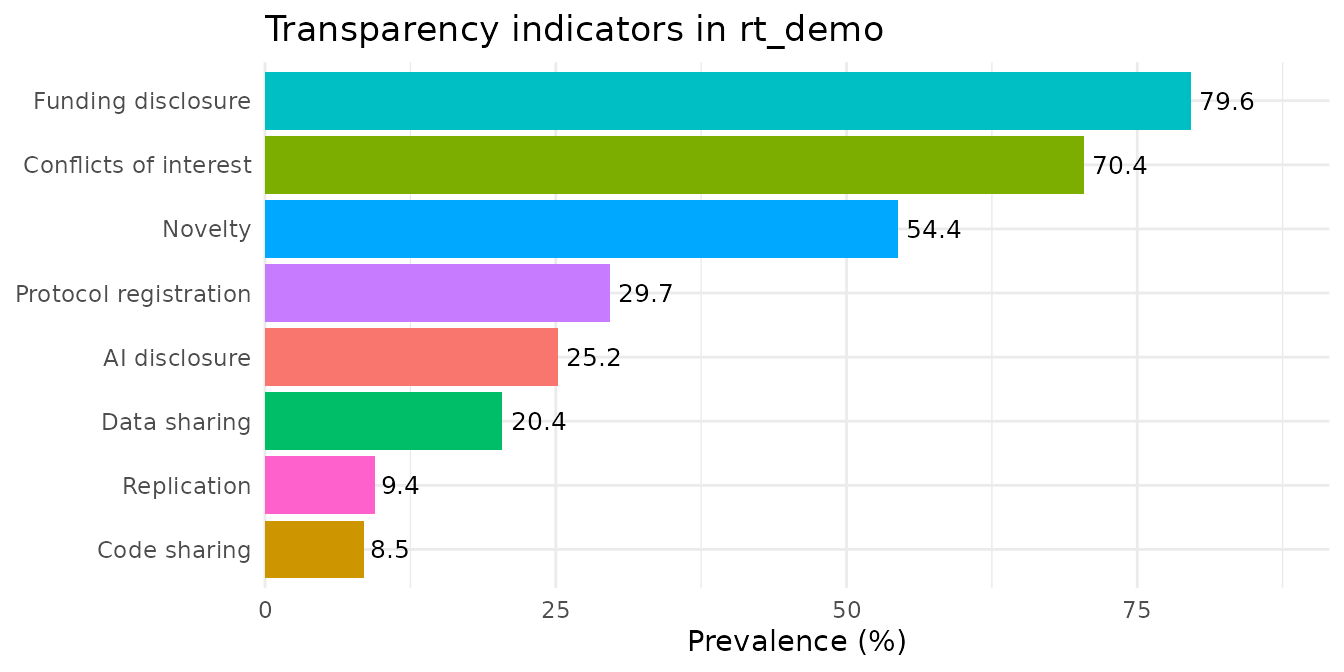
rt_plot() returns a ggplot, so it composes
with the usual ggplot2 layers. The default is a prevalence bar
chart:
Use type = "trend" with a year column to see prevalence
over time:
rt_plot(rt_demo, type = "trend", year = "year")
#> Warning: Removed 13 rows containing missing values or values outside the scale range
#> (`geom_line()`).
#> Warning: Removed 13 rows containing missing values or values outside the scale range
#> (`geom_point()`).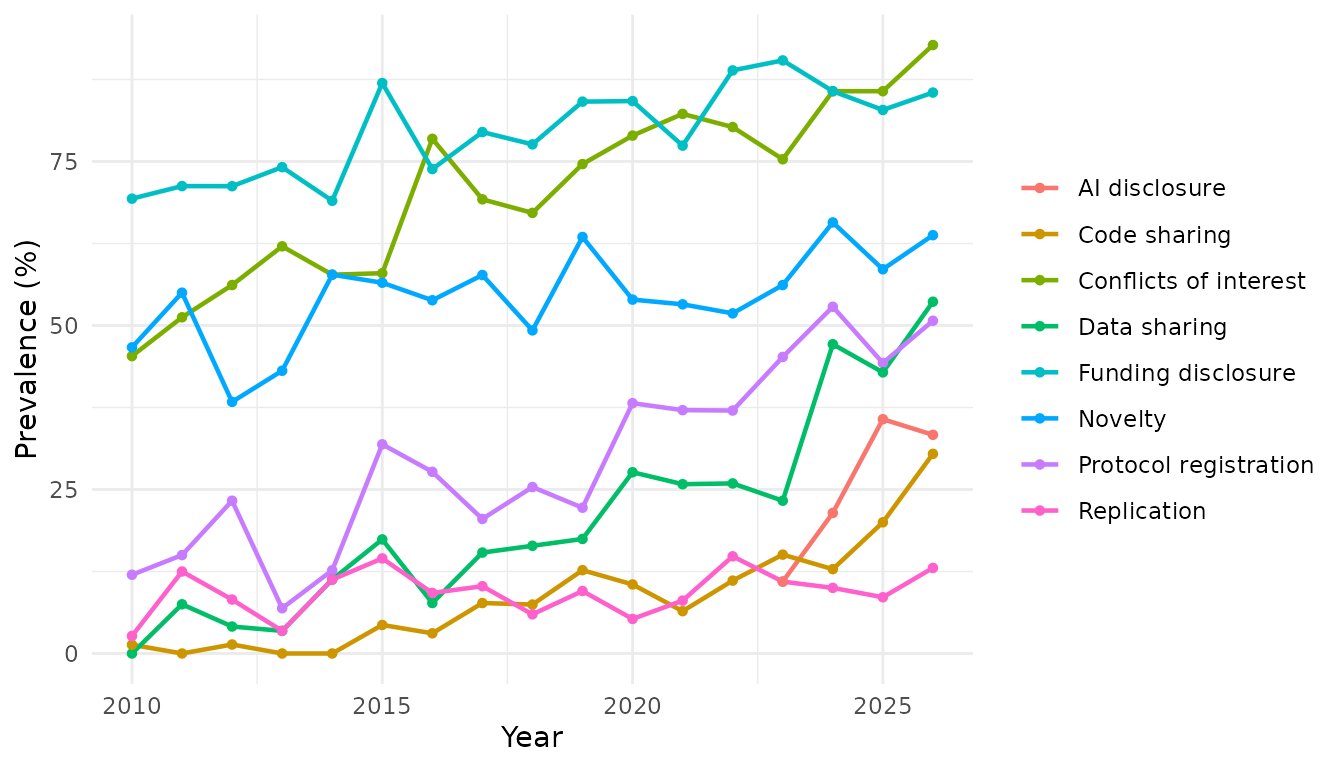
The AI-disclosure line begins only in 2023, because the indicator is
NA before then; the rising data-sharing and AI lines
illustrate the kind of trend these summaries are meant to surface.
Restrict a plot to particular indicators with indicators =,
for example to follow AI-use disclosure on its own:
rt_plot(rt_demo, type = "trend", year = "year", indicators = "is_ai_pred") +
  ggtitle("Disclosure of generative-AI use, 2023 onward")
#> Warning: Removed 13 rows containing missing values or values outside the scale range
#> (`geom_line()`).
#> Warning: Removed 13 rows containing missing values or values outside the scale range
#> (`geom_point()`).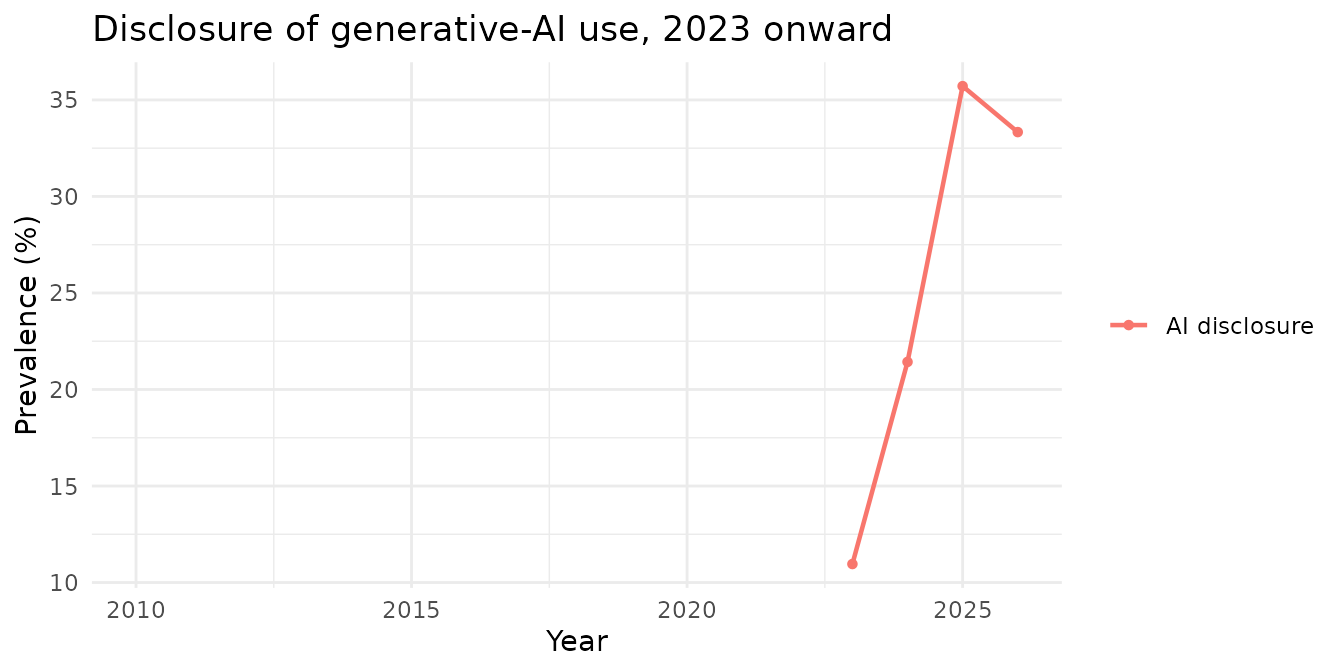
Set adjusted = TRUE in either plot to show the
error-corrected prevalence instead of the apparent prevalence.
Putting it together
A typical analysis is therefore: run a detector over your corpus, stack the rows, then
results <- purrr::map_dfr(xml_files, rt_all_pmc)
rt_summary(results)                       # prevalence + corrected prevalence
rt_score(results)                         # per-article practice count
rt_plot(results, type = "trend", year = "year")
For the per-indicator detection methodology, see
vignette("rtransparency").